Dubrovnik

The prosperity of the city of Dubrovnik was historically based on maritime trade. As the capital of the Republic of Ragusa, amaritime republic, the city achieved a high level of development, particularly during the 15th and 16th centuries. Dubrovnik became notable for its wealth and skilled diplomacy. Old City


Between the 14th century and 1808, Dubrovnik ruled itself as a free state, although it was a vassal from 1440 to 1804 of the Ottoman Empireand paid an annual tribute to its sultan.[10] The Republic reached its peak in the 15th and 16th centuries, when its thalassocracy rivalled that of the Republic of Venice and other Italian maritime republics.
For centuries, Dubrovnik was an ally of Ancona, the other Adriatic maritime republic rival of Venice, which was the Ottoman Empire's chief rival for control of the Adriatic. This alliance enabled the two towns set on opposite sides of the Adriatic to resist attempts by the Venetians to make the Adriatic a "Venetian Bay", also said[by whom?] to control directly or indirectly all the Adriatic ports. Ancona and Dubrovnik developed an alternative trade route to the Venetian (Venice-Austria-Germany): this route started from the East, passed through Dubrovnik and Ancona, then interested Florence and finally Flanders. Stradun (pronounced [strǎduːn]) or Placa (Stradone or Corso) is the main street of Dubrovnik, Croatia. The limestone-paved pedestrian street runs some 300 metres through the Old Town, the historic part of the city surrounded by the Walls of Dubrovnik. he site of the present-day street used to be a marshy channel which separated Ragusa from the forest settlement of Dubrava before it was reclaimed in the 13th century.[3] Stradun stretches through the walled town in the east-west direction, connecting the western entrance called the "Pile Gate" (Vrata od Pila) to the "Ploče Gate" (Vrata od Ploča) on the eastern end. Both ends are also marked with 15th-century fountains (the so-called Large Onofrio's Fountain in the western section and the Small Onofrio's Fountain on the east end) and bell towers(the Dubrovnik Bell Tower to the east end and the bell tower attached to the Franciscan monastery to the west).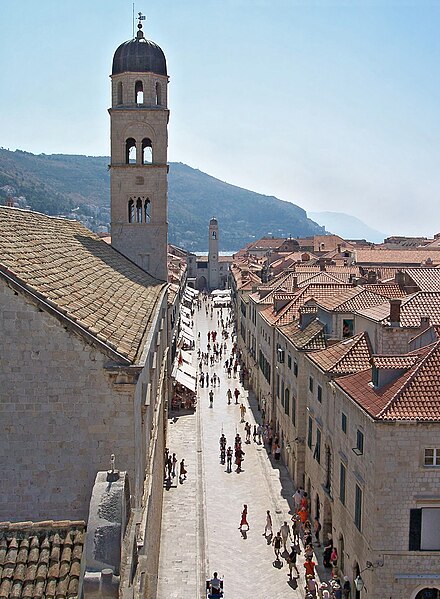
Stradun became the city's main thoroughfare in the 13th century, and its current appearance was for the most part created following the devastating 1667 earthquake in which most of the buildings in Ragusa (as Dubrovnik was called back then) were destroyed. Before the earthquake the houses which line the street were not so uniformly designed as they appear today, with many of them featuring arcades and elaborate decorations.[2] Following the 1667 earthquake and a large fire which broke out immediately afterwards, the Republic of Ragusapassed a law which specified the layout of all future residential buildings constructed in the city. Minčeta is the northernmost and most impressive fortresses in the city walls; most prominent point of the defense system of Dubrovnik to the mainland. With St. Blaise, a kind of symbol of the city of Dubrovnik.
Minčeta fort was named after a family of aristocratic Dubrovnik Menčetić who donated the land for its construction. It is a large circular tower, which is based on a broad and solid bulwark; their height and impressive volume dominates the northwestern part of the city and the high wall. Minčeta has thrown battlement, supported by a molded stoneware consoles. The parapet has a clear aesthetic, not a fortified position, which means that the tower itself during the Dubrovnik Republic was almost invincible stronghold.
 With Minčete as the highest point of Dubrovnik, a magnificent view of the city and its location between the steep slopes of Mount Srd on one side and the open sea on the other.

Нема коментара:
Постави коментар